

- Seek Regional Tax Harmonisation & Revenue Boost For West Africa
Abuja, Nigeria – May 11, 2026: The West African Tax Administration Forum (WATAF), in partnership with Tax Justice Network Africa (TJNA), convened a high-level Parliamentary Tax Session at the ECOWAS Parliament aimed at strengthening domestic revenue mobilization, advancing regional tax harmonization, and addressing illicit financial flows (IFFs) across West Africa.
The one-day regional dialogue was held on Monday, May 11, during the Sixth Legislature’s 2026 First Ordinary Session of the ECOWAS Parliament at the International Conference Centre in Abuja, Nigeria.
It brought together ECOWAS lawmakers, tax administrators, WATAF and TJNA experts, development partners, and regional stakeholders to examine practical policy and legislative solutions to strengthen fiscal governance across the region.
Speaking at the opening of the engagement on behalf of WATAF Executive Secretary, Jules Tapsoba, WATAF Communication and IT Manager, Danicius Kaihenneh Sengbeh, stressed that the dialogue was not merely about taxation, but about “sovereignty, fairness, accountability, and the future we seek to build for the people of West Africa.”
He stated that governments across West Africa continue to face growing pressure to finance infrastructure, healthcare, education, climate resilience, security, and opportunities for the region’s rapidly growing youth population, while illicit financial flows, fragmented tax systems, weak transparency frameworks, and emerging digital economy challenges continue to undermine domestic revenue mobilization.
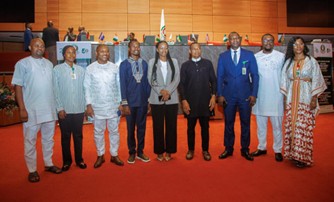
WATAF, TJNA and ECOWAS 4th Deputy Speaker after the event on Monday, May 11, 2026 “At WATAF, we firmly believe that effective tax systems are not merely instruments for revenue collection, but instruments for nation building, economic justice, and public trust,” he stated.
Sengbeh further underscored the indispensable role of Parliamentarians in strengthening legislative oversight, supporting regional tax reforms, promoting accountability, and advancing public confidence in fiscal governance systems across the region.
Providing an overview of the session, WATAF Research Manager, Dr. Sidnoma Nita, highlighted the importance of translating existing ECOWAS tax directives and transparency frameworks into effective implementation across Member States.
Dr. Nita noted that the challenge facing the region is no longer the absence of frameworks, but the transition from commitments to implementation.
She explained that the Parliamentary Session aimed to strengthen awareness and engagement of lawmakers on regional tax harmonization, illicit financial flows, and sustainable domestic revenue mobilization while promoting mutual learning and stronger regional cooperation.
The Parliamentary Tax Session focused on key issues, including operationalizing ECOWAS tax directives, transfer pricing, VAT harmonization, digital taxation, beneficial ownership transparency, exchange of information, extractive sector taxation, fiscal governance, and financing sustainable development.
Technical presentations were delivered by WATAF and TJNA experts, including Mr. Jonas Igwe on Operationalizing ECOWAS Tax Directives for Domestic Resource Mobilization and Regional Tax Harmonization; Dr. Zandile Ndebele on Addressing Tax-Related Illicit Financial Flows through Legislative Frameworks and Transparency Measures; and John Thomi on Fiscal Governance, Extractive Taxation and Financing Sustainable Development in ECOWAS.
The discussions also highlighted the Anti IFF Policy Tracker developed by the African Union Commission and TJNA, which has been piloted in several ECOWAS Member States including Côte d’Ivoire, Ghana, and Liberia to assess legal, institutional, data, and inter agency mechanisms used to combat illicit financial flows.
WATAF and TJNA experts noted that Africa continues to lose billions of United States dollars annually through illicit financial flows, particularly within the extractive sector, thereby weakening the continent’s ability to finance infrastructure, healthcare, education, and broader development priorities.
During the engagement, lawmakers actively participated in discussions and raised concerns regarding cross border trade, taxation of multinational corporations, informal sector taxation, extractive industry governance, artificial intelligence in revenue administration, donor dependency, and the protection of Africa’s taxing rights.
Several lawmakers emphasized the need for stronger regional cooperation, enhanced information sharing, improved tax transparency systems, and more effective legislative oversight mechanisms to combat illicit financial flows across the region.
The experts maintained that stronger regional coordination, technology driven tax administration systems, enhanced transparency frameworks, and coordinated legislative reforms remain essential to improving domestic revenue mobilization and strengthening accountability outcomes across West Africa.
Speaking at the close of the session, Fourth Deputy Speaker of the ECOWAS Parliament, Billay G. Tunkara, commended WATAF for its steadfast role in strengthening tax administrations and advancing regional tax cooperation across West Africa.
He praised WATAF Executive Secretary, Jules Tapsoba, and TJNA for assembling a strong team of technical experts whose presentations enriched discussions and provided lawmakers with valuable and practical policy insights.
Hon. Tunkara emphasized that African countries must increasingly broaden their tax bases and mobilize internal resources rather than relying heavily on borrowing and external support.
He further called on ECOWAS Member States to strengthen regional integration, ratify and domesticate regional tax directives, and support coordinated reforms aimed at promoting sustainable and self-reliant economies across West Africa.
The Parliamentary Session forms part of West African Tax Administration Forum’s broader mandate to strengthen tax administration systems, promote regional cooperation, and support sustainable domestic revenue mobilization across West Africa.

Comments are closed.