

By Amos Harris
MONROVIA, LIBERIA — The Liberia Drug Enforcement Agency (LDEA) has revealed that it confiscated illicit drugs and controlled substances with an estimated street value of more than US$8.2 million between October 2025 and June 2026. This disclosure underscores the massive scale of drug trafficking networks operating within the country, despite intensified enforcement operations across Liberia’s fourteen leeward counties.
The strategic release of these statistics coincided with Liberia joining the global community to observe the 2026 International Day Against Drug Abuse and Illicit Trafficking, held under the national theme, “Strengthening Communities for a Drug-Free Liberia.” While government officials celebrated the recent enforcement successes, the staggering volume of narcotics moving through local trade routes has renewed intense public concern over Liberia’s capacity to contain a deepening public health crisis.
According to the official report issued by the LDEA, the total value of the seized illegal narcotics stands at exactly US$8,270,078.39, which translates to approximately L$1.57 billion. The sheer volume of the intercepted haul indicates that massive quantities of illegal substances flow steadily across borders and circulate through local communities despite ongoing security interventions.
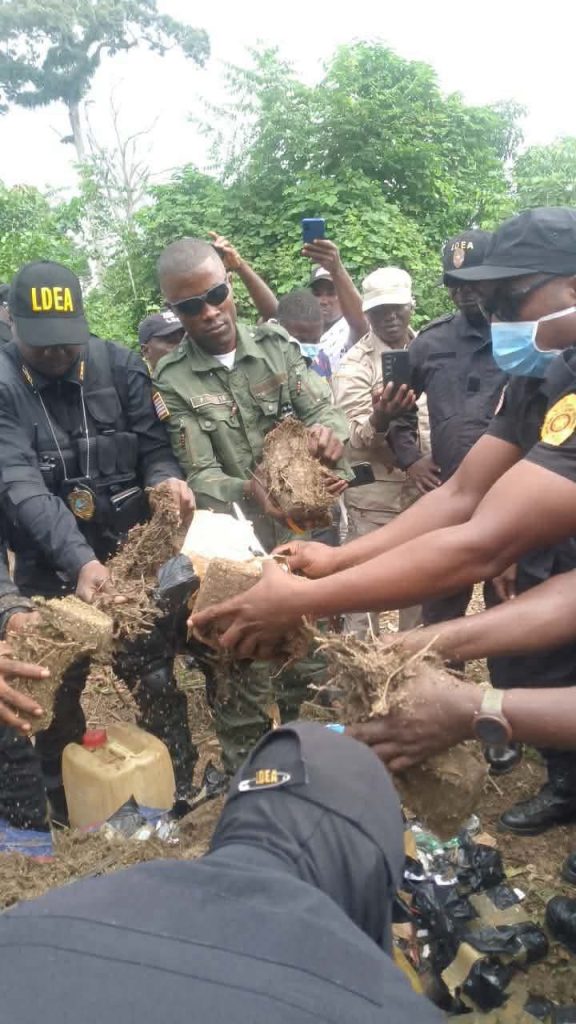
A detailed look at the confiscated narcotics reveals a highly diverse and dangerous illicit market. Security forces intercepted 2,353.396 kilograms of marijuana, 4,263.03 grams of cocaine, 5,880.6 grams of heroin, and 15,065.44 grams of the highly destructive synthetic mixture known as kush. Additionally, officers seized 337,246 pills of the pharmaceutical opioid Tapentadol, 413.7 grams of drug precursors, and 2.384 kilograms of methamphetamine. These numbers have intensified questions regarding the permeability of national borders and the increasing sophistication of international trafficking syndicates.
Geographically, county-by-county data highlights specific smuggling hubs and transit corridors. Grand Cape Mount County recorded the largest marijuana seizure at 790.4 kilograms and also led the nation in Tapentadol interceptions by accounting for more than 200,000 pills, reinforcing long-held fears that the coastal county serves as a primary gateway for narcotics entering the country. Meanwhile, Sinoe County accounted for the overwhelming majority of hard drugs, yielding more than 5.2 kilograms of heroin and nearly 11 kilograms of kush. Grand Bassa County registered the largest single cocaine seizure at 1,514 grams, while Nimba County led the country in methamphetamine seizures with 1.5 kilograms, signaling the dangerous expansion of synthetic stimulants into northern Liberia.
Speaking during the World Drug Day event, LDEA Officer-in-Charge DCP Fitzgerald T.M. Biago classified drug abuse and illicit trafficking as an existential threat to Liberia’s public health, national security, and economic stability. He warned that narcotics are actively destroying the potential of young citizens, tearing families apart, and driving up localized crime rates. While emphasizing that the LDEA remains fully committed to enforcing drug laws and dismantling syndicates, Biago cautioned that simple arrests and seizures are insufficient to win the war on drugs. He maintained that defeating the epidemic demands a synchronized national commitment, urging parents, teachers, religious bodies, and community leaders to actively join preventative education efforts to protect vulnerable youth from criminal exploitation.
Addressing the youth directly, Biago implored young Liberians to reject illicit substances and instead pursue education and vocational training to build sustainable futures. He also asked parents to stay heavily involved in their children’s daily lives, citing early parental guidance as a critical line of defense against addiction. Biago extended appreciation to security partners, healthcare professionals, and international civil society organizations for their ongoing support, calling for even tighter multi-sector collaboration to suppress both the supply and demand sides of the narcotics trade.
Despite the praise surrounding the LDEA’s tactical achievements, analysts and members of the public argue that the massive size of the seizures proves that law enforcement strategies are struggling to outpace the growth of the criminal underworld. Observers point out that Liberia has evolved from a simple transit corridor into a lucrative domestic consumer market for marijuana, cocaine, heroin, kush, and dangerous prescription opioids. Consequently, civic groups are demanding more aggressive border surveillance, harsher judicial penalties for major traffickers, the establishment of comprehensive public rehabilitation facilities, and broader investment in youth employment.
Representing the executive branch, Information Minister Jerolinmek M. Piah urged the LDEA to expedite its investigations into a separate, high-profile US$19 million drug case. Piah warned that prolonged institutional delays risk damaging public confidence in the administration’s stated zero-tolerance policy against narcotics. He emphasized that complete transparency and swift judicial actions are non-negotiable for maintaining public trust.
Minister Piah also stressed that the media serves as an indispensable tool in the national anti-drug campaign. He challenged the LDEA to foster closer partnerships with investigative journalists to expose trafficking networks and improve public sensitization. Ultimately, officials agree that a coordinated, transparent national response linking the government, media houses, local communities, and international development partners remains the only viable path to overcoming what has become one of Liberia’s most pressing socio-economic challenges.

Comments are closed.