

Monrovia, Liberia; September 16, 2026: “Democracy is more than elections. Democracy is a daily practice of ensuring human rights, the rule of law, and the meaningful participation of all people.” Said the United Nations Secretary-General António Guterres on International Day of Democracy 2026.
For many young Liberians, democracy has long been associated with Election Day political rallies, and campaign promises. On 15 September 2026 in Monrovia, that understanding was challenged.
As Liberia joined the global community in commemorating the International Day of Democracy, 75 young leaders, students, civil society representatives, political actors, and development partners gathered in Monrovia for a dialogue that shifted the conversation from elections to everyday participation, accountability, and inclusive governance. Organized by the Federation of Liberian Youth (FLY) in partnership with the Netherlands Institute for Multiparty Democracy (NIMD) under the Liberia Electoral Support Project (LESP), the event created a safe space for young people to reflect on one central question: What does democracy really mean for Liberia’s young people?
The project supports national institutions and citizens in advancing democratic governance, peaceful participation, and accountable public institutions. It is managed by UNDP and implemented in partnership with NIMD and UN Women, with support from the European Union, Ireland, and Sweden.
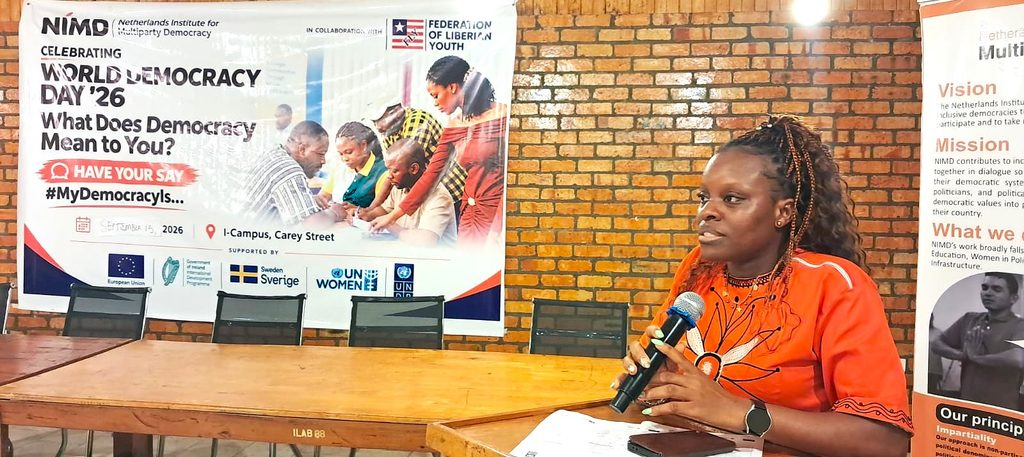
Rather than delivering prepared speeches, participants challenged long-held assumptions about democratic participation, examining the barriers that continue to limit young people’s influence in public decision-making.
Opening the dialogue, Relda Scott, Programme Officer at NIMD, reminded participants that democracy extends far beyond voting. “Democracy is more than an election. It is about participation, inclusion, accountability, dialogue, ensuring that every citizen has a voice in decisions that affect their lives.”
Her message echoed this year’s United Nations theme on deliberative democracy, emphasizing that stronger democracies are built through continuous dialogue, collaboration, and citizen engagement. Scott challenged young people to broaden their understanding of political participation beyond election politics by addressing the issues that directly affect their lives.
Drawing from NIMD’s recent regional youth consultations across Liberia, she highlighted three priorities consistently highlighted by young people: quality education, skills development linked to employment opportunities, and sexual and reproductive health.
Addressing these concerns, she noted, is essential for strengthening democratic participation and improving young people’s wellbeing. “For young people especially, democracy provides an opportunity not only to demand change, but to actively contribute to shaping the policies and decisions that determine their future.”
The discussion quickly evolved into an honest reflection on the realities confronting Liberia’s youth.
Speaking on behalf of FLY, Rosetta Fardolo, Head of Secretariat, challenged participants to examine whether democracy truly reflects the principle of inclusion that it promises.
While acknowledging that young people constitute the majority of Liberia’s population, she questioned why their representation in political leadership and national decision-making remains disproportionately low.
She encouraged participants to move beyond beneficiaries of governance processes and become active contributors to shaping them.
Throughout the discussion, participants examined the structural barriers that continue to affect democratic participation, including age, gender, economic inequality, political party structures, and access to leadership opportunities.
Rather than focusing solely on political competition, the dialogue encouraged participants to see democracy as a shared responsibility requiring accountability, constructive engagement, and commitment to the national interest.
The conversation also reinforced the importance of issue-based participation, a principle promoted through NIMD’s Democracy Schools and youth engagement initiatives. Participants agreed that addressing unemployment, education, technical and vocational training, health, and opportunities for young people are democratic issues that deserve equal attention alongside electoral politics.
For many in attendance, the dialogue was an opportunity to rethink democracy as a continuous process of listening, engaging, and working together to solve national challenges.
The International Day of Democracy dialogue forms part of broader efforts by the Liberia Electoral Support Project to strengthen inclusive democratic governance by promoting meaningful participation of young people and women in public life.
As participants departed, they carried with them a renewed understanding that democracy is not simply about choosing leaders every election cycle. It is about ensuring that every voice counts, and that every generation has a meaningful role in shaping Liberia’s future.

Comments are closed.