

By Amos Harris
Monrovia, Liberia – July 23, 2025 – Liberia has taken a monumental stride in environmental governance and scientific advancement with the official commissioning of its first-ever state-of-the-art Environmental Laboratory. This landmark facility, housed within the newly completed headquarters of the Environmental Protection Agency (EPA) at Mamba Point in Monrovia, was formally dedicated by Vice President Jeremiah Kpan Koung in a historic ceremony.
Vice President Koung hailed the occasion as a proud milestone in Liberia’s pursuit of environmental sustainability and institutional modernization. He declared the new laboratory marks the dawn of a new era in environmental protection and science-based policymaking.
“This laboratory is more than just a room with equipment,” Vice President Koung asserted. “It is a foundation for evidence-based regulation. It will allow us to monitor water and air quality, track coastal erosion, analyze climate data, and make informed decisions to protect public health and the environment.”
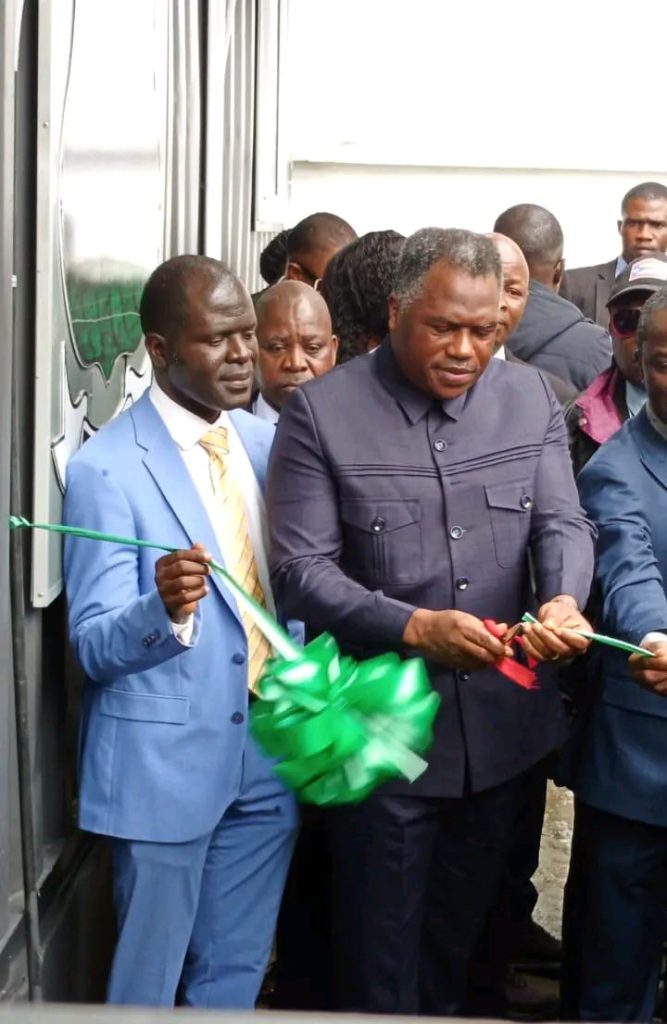
The Vice President emphasized that the new facility, alongside the completion of the EPA’s modern headquarters, signals a renewed national resolve to enforce environmental standards with integrity and professionalism, aligning with the Boakai administration’s ARREST Agenda for Inclusive Development.
“For too long, the EPA operated from rented buildings that did not meet even the most basic environmental standards the institution was mandated to uphold,” he said. “Today, that contradiction ends. This new facility reflects the seriousness of Liberia’s commitment to climate action and environmental justice.”
Dr. Emmanuel K. Urey Yarkpawolo, EPA’s Executive Director, hailed the laboratory as a “game-changer” for Liberia’s environmental landscape, recalling years of operational constraints due to substandard infrastructure and inadequate resources.
“In the past, we received cutting-edge equipment from international partners, but we lacked the physical infrastructure to make use of it,” Dr. Urey explained. “Now, with this modern laboratory, we are equipped to carry out critical scientific functions internally.”
Valued at nearly US$100,000, the laboratory is fitted with high-tech instrumentation capable of conducting a broad range of environmental analyses. These include water and air quality testing, soil analysis, climate monitoring, and even forensic environmental investigations — services which previously had to be outsourced at significant financial and time costs.
The laboratory is also poised to support Liberia’s engagement with the global carbon market. Dr. Urey revealed that the EPA, in collaboration with the Coalition of Rainforest Nations, the United Nations Development Programme (UNDP), and Novasphere, is currently conducting a nationwide forest and carbon stock inventory. The objective is to quantify Liberia’s carbon trading potential and establish mechanisms for equitable benefit-sharing.
According to Dr. Urey, a draft national carbon market policy has already been developed and reviewed, laying the groundwork for carbon credit ownership and distribution that aligns with Liberia’s commitments under the Paris Agreement.
Vice President Koung further disclosed that the EPA’s development ambitions extend well beyond the current milestone. He announced plans for the construction of a permanent, climate-resilient EPA headquarters within the next three to five years. The future facility, he said, would be fully powered by renewable energy and serve as a model of green infrastructure in West Africa.
“Today’s ribbon-cutting is not just ceremonial,” Koung told the audience. “It is a reaffirmation of our national commitment to building a cleaner, safer, and more sustainable Liberia — not just for today, but for generations to come.”
The high-profile dedication ceremony brought together a wide array of stakeholders, including government officials, representatives of diplomatic missions, international development partners, environmental advocates, civil society organizations, and EPA staff. Many attendees praised the initiative as a long-overdue investment in scientific capacity-building and environmental governance in Liberia.
“This is not just an investment in equipment or infrastructure,” one development partner remarked. “It is an investment in the future of Liberia — in the health of its people, the resilience of its ecosystems, and the credibility of its institutions.”
The facility’s completion comes at a time when global attention is increasingly focused on climate change, environmental degradation, and the need for evidence-driven action. Liberia, a country rich in biodiversity and natural resources, has often been cited as a key player in regional and global conservation efforts.
With the inauguration of the new EPA laboratory, Liberia now joins the ranks of countries equipped to scientifically monitor and respond to environmental challenges domestically — an achievement that stakeholders say will not only boost national policy but also enhance Liberia’s voice in global climate negotiations.
In closing, Vice President Koung called on all sectors of Liberian society — from policymakers to students, from civil society to the private sector — to rally around the EPA’s vision of a cleaner, greener Liberia.
“This laboratory is a symbol,” he said, “But more importantly, it is a tool — a tool that we must all use, support, and protect if we are to truly build the future we want.”

Comments are closed.